


Simon Body
As airports expand they face a “growth paradox” created by environmental and labour constraints, says Simon Body Fujitsu’s chief technology officer for aviation and travel. To resolve this, the aviation industry must look beyond scaling physical infrastructure and instead cultivate an ecosystem of sentience
Global aviation stands at a historic inflection point. As passenger volumes surge toward unprecedented highs, traditional models of physical expansion — relying on concrete, gates, and runways – face myriad delivery challenges.
At Fujitsu, we have been looking at an alternative approach that moves the focus from isolated asset management to a unified data fabric, shifting the operational paradigm from reactive troubleshooting to a self-optimising ecosystem.
By integrating multi-dimensional data layers into a cognitive network, international hubs can unlock latent capacity, elevate safety baselines, and secure long-term viability.
Predictive flow models and real-time passenger analytics enable existing terminal spaces to dynamically absorb higher passenger volumes without the capital expenditure

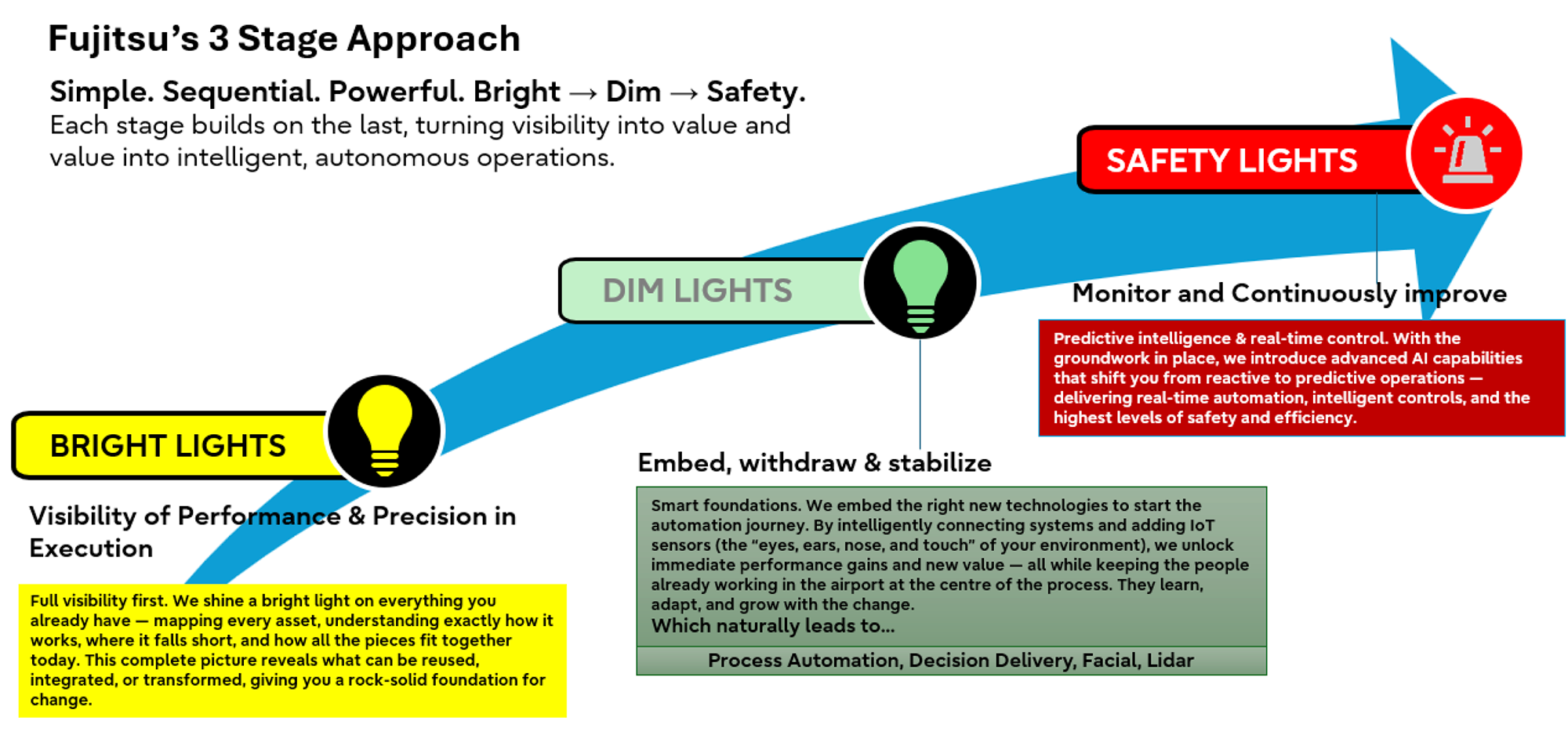
Steps towards a cognitive hub
The Vision for Scale, Expansion, and Financial Growth
A sentient airport decouples business growth from physical footprints by maximising data liquidity across historically siloed domains.
Predictive flow models and real-time passenger analytics enable existing terminal spaces to dynamically absorb higher passenger volumes, safely accommodating millions of additional travellers without the capital expenditure or environmental friction of major terminal brick-and-mortar extensions.
By transforming the terminal into a frictionless corridor, passenger transit through security becomes fluid, naturally extending retail and lounge dwell times.
Airside, autonomous logistics and predictive orchestration optimise ground handling assets to the second.
Baggage tugs, fuel crews, and catering operations synchronise precisely around real-time demand curves, eliminating compounding turnaround delays and significantly scaling total cargo and freight capacity.

image supplied by Fujitsu
Advancing Health and Safety
The ultimate expression of airport sentience lies in transforming high-velocity, high-risk operational environments into spaces of absolute safety. A responsive digital nervous system elevates standard surveillance into an orchestrator of protective health and security measures:
Proactive Anomaly Detection: Blending advanced LiDAR, computer vision, and thermal sensing allows the central operational framework to secure a near-perfect probability of anomaly detection, preemptively flag security breaches, and coordinate immediate responses.
Risk Mitigation for Personnel: Entrusting repetitive, high-risk airside freight movements to autonomous loaders fundamentally insulates human ground crews from hazardous heavy machinery operating zones.
Biosecurity and Air Quality Lifecycle: Deep-terminal Wi-Fi and environmental sensors actively manage indoor biosecurity by tracking air distribution, balancing humidity levels to minimise virus transmission vectors, and eliminating micro-hazards like wet floors before accidents occur.
Simulated Crisis Coordination: In critical situations, the operational Digital Twin acts as an instant simulator, processing optimal evacuation strategies and guiding crisis responses with microsecond precision.
Navigating the Core Strategic Challenges
1. Government Regulation: Fragmented cross-border regulatory frameworks frequently restrict the global portability of digital identity frameworks, slowing down borderless biometric corridors.
The Strategic Solution: Global aviation networks must actively champion uniform, cross-border interoperability standards, such as ICAO's Digital Travel Credentials, and forge international public-private coalitions to standardise data governance.
2. Funding and Regulatory Approvals: Capital justification models can face resistance when evaluating abstract technological transformations, while airside safety certification for autonomous fleets involves stringent validation.
The Strategic Solution: Implement a self-sustaining, phased modernisation framework. Initial visibility improvements yield massive utility and labour optimisations that organically self-fund subsequent cognitive and autonomous software layers.
3. Cultural Evolution and Ways of Working: Transitioning automated choices from operational advice to agentic execution introduces natural organisational inertia and resistance from legacy operational teams.
The Strategic Solution: Reframe the organisational narrative away from automation as labour displacement toward technology as human elevation. By offloading high-volume, repetitive data triage to cognitive frameworks, human teams are liberated to focus on handling highly complex exceptions and driving personalised customer care.
The evolution toward a sentient framework is a structural imperative for the future aviation model
The Strategic Horizon
The evolution toward a sentient framework is a structural imperative for the future aviation model. The question is no longer whether modern infrastructure must transition, but which global hubs will establish the blueprint for this new era.
Watch Fujitsu’s short video: Revolutionising airports - the rise of sentience
Simon Body is Fujitsu’s chief technology officer for aviation and travel