

Plans to transform Coventry Airport into a major battery manufacturing hub have moved forward after local authorities approved detailed proposals for a £2.5bn redevelopment.
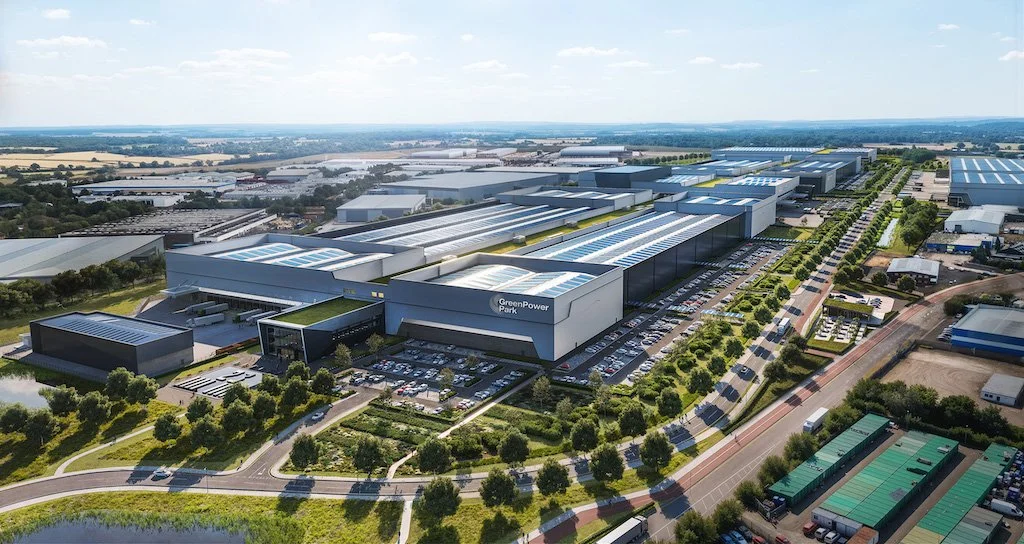
Image: GreenPower Park
Warwick District Council has granted planning permission for the scheme, known as GreenPower Park, which will convert the airport site into a large-scale “gigafactory” focused on battery production, clean energy, and advanced manufacturing. The development is being delivered through a partnership between Coventry City Council and the Rigby Group.
Under the approved plans, the site will include seven industrial buildings with a combined floorspace of around 4.8m square feet. Individual units are expected to range from approximately 69,000 square feet to as much as 1.5m square feet, making it one of the largest advanced manufacturing complexes in the Midlands.
The decision builds on earlier outline planning consent granted in 2022 for a battery factory at the site, but now provides detailed designs covering layout, scale, and landscaping.
Coventry Airport opened as Baginton Aerodrome in 1936 and was used as a Royal Air Force fighter base during the Second World War. In the post-war decades it developed into a regional airport handling passenger charters and freight, with periodic attempts to establish scheduled low-cost routes in the 2000s.
Those services proved short-lived, and after financial difficulties the airport was acquired in 2009 by the Rigby Group, which shifted its focus away from commercial passenger traffic. Under this ownership, the site has primarily operated as a general aviation airfield, supporting business aviation, pilot training and emergency services, reflecting a long-term decline in its role as a mainstream passenger airport.
Located around three miles southeast of Coventry city centre, the airport lies close to the A45, linking Coventry with Birmingham, and within easy reach of the M6, M69 and M40 motorways.
The project now forms part of the Coventry and Warwick Investment Zone, an initiative intended to attract private investment through incentives such as business rates relief and tax benefits. The GreenPark Power development is designed to support growth in electric vehicle battery technology and related industries.
The airport itself, which has operated primarily as a general aviation facility in recent years, is due to close permanently in June 2026 to allow the redevelopment to proceed.