

ATI launches aerospace strategy targeting four-fold growth to 2050
The Department for Business and Trade and Innovate UK backed Aerospace Technology Institute (ATI) has unveiled a new technology strategy aimed at significantly increasing the value of the UK aerospace sector over the next 25 years, with a focus on next-generation aircraft technologies, industrial competitiveness and decarbonisation.
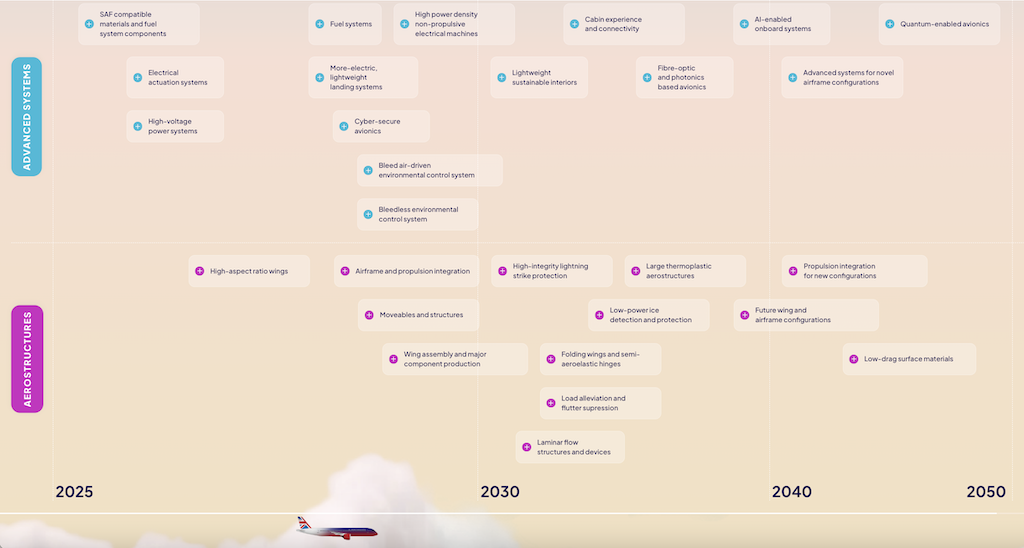
image: ATI roadmap (extract)
The strategy, titled “Engineering Growth”, sets out a roadmap intended to help the UK aerospace industry double its market value from $9bn in 2024 to $18bn by 2035 and expand it to $41bn by 2050. The plan identifies opportunities linked to new aircraft technology and operational improvements, which says ATI, have the potential to avoid 3Gt of carbon emissions by 2050 and 16Gt by 2070
The Aerospace Technology Institute (ATI), an independent, non-profit organisation, sets the national technology strategy for the UK’s civil aerospace sector. Funded jointly by the UK Government's Department for Business and Trade (DBT) and industry, the ATI drives innovation in sustainable aviation, such as zero-carbon emission aircraft and ultra-efficient technologies.
Announcing the strategy, the ATI said the UK could strengthen its position in areas where it already has established capabilities, including ultra-efficient propulsion systems, advanced wing technologies and lightweight aircraft systems. The organisation said these technologies would need to reach commercial readiness by 2030 in order for the UK to capture a larger share of future aerospace programmes.
The strategy also places emphasis on meeting environmental targets across the aviation sector. The ATI said investment priorities would support both economic growth and the transition toward lower-emission aviation technologies, aligning with wider industry efforts to reach net zero carbon emissions by 2050.
The announcement comes alongside continued government backing for aerospace research and development. The UK government in 2025 committed £2.3bn in funding for the ATI Programme through to 2035 (meaning a total investment of £8bn since its formation in 2014), intended to support collaborative aerospace technology projects involving industry and research organisations.
According to the ATI, the strategy is designed to guide future investment decisions across the sector and help position UK aerospace suppliers for participation in forthcoming aircraft development programmes.