

UK airports and aviation operators could face greater resilience obligations under proposals for a more coordinated national approach to emergency preparedness, following a House of Lords committee warning that the country is seriously underprepared for growing and interconnected threats.
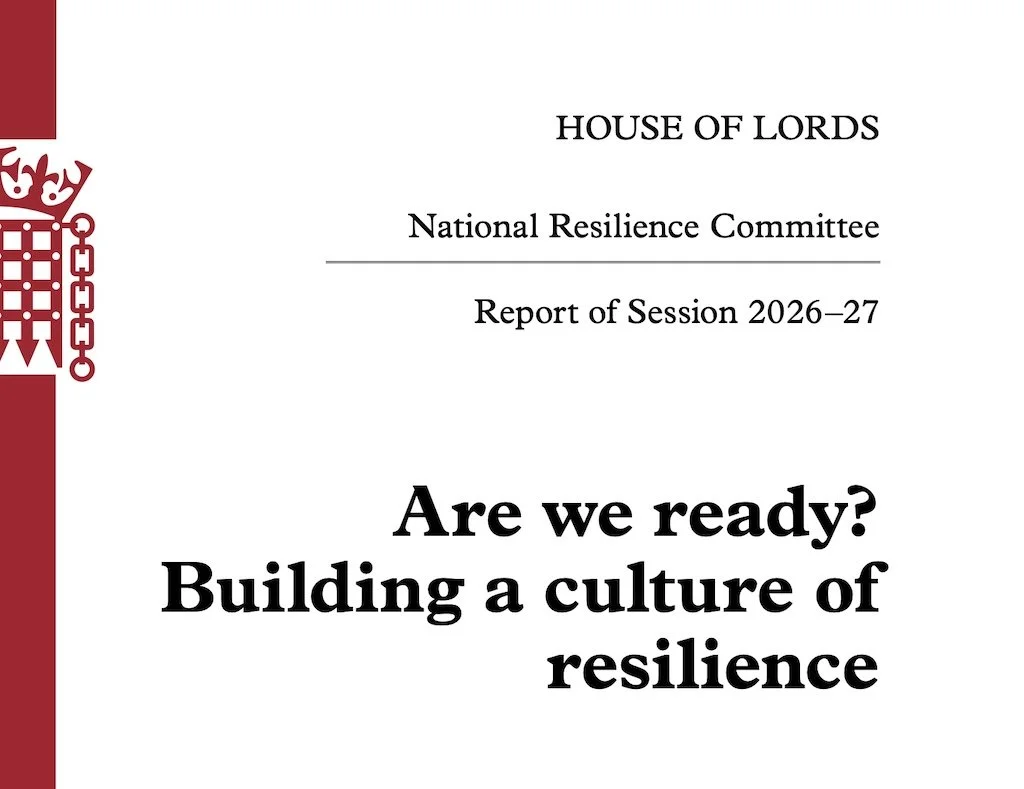
image: National Resilience Committee
The National Resilience Committee's report, Are we ready? Building a culture of resilience calls for a fundamental change in how the Government and businesses prepare for major disruption. It argues that existing arrangements are fragmented, focus too heavily on individual emergencies and do not adequately address the possibility of several incidents occurring simultaneously or triggering wider consequences.
Although the report does not set out aviation-specific recommendations, its findings have direct implications for airports, airlines and the wider aviation supply chain, which depend on reliable power, telecommunications, digital infrastructure, fuel supplies and transport connections.
The committee highlights the vulnerability of critical infrastructure to cyber attacks, hostile activity, extreme weather, disruption to subsea cables and prolonged power outages. It warns that a failure in one sector can have cascading effects across others, with existing preparedness arrangements insufficiently equipped to deal with such scenarios.
Among its recommendations, the committee wants businesses whose continued operation is essential to national resilience to face statutory preparedness and business continuity requirements. These organisations would also be subject to regular stress testing, with the Government expected to establish a tiered framework defining which businesses fall into this category and what obligations they should meet.
For aviation, this raises questions about how preparedness requirements might apply to major airports, air traffic management providers, airlines and companies responsible for critical airport infrastructure and services. The sector's reliance on interconnected systems means that disruption to electricity, telecommunications, fuel distribution or digital networks could affect airport operations well beyond the location of an initial incident.
The committee also recommends that critical national infrastructure operators receive relevant threat intelligence through designated, security-cleared personnel. It wants the Government to establish regional coordination centres to improve the relationship between national emergency planning and local delivery.
Communications resilience is another concern. The report warns that the UK's dependence on digital communications leaves essential services exposed to widespread power failures and damage to subsea cables. It calls for backup communications arrangements to be developed and regularly tested, alongside stronger cyber security regulation.
The committee's recommendations come shortly after the Department for Transport published its own Transport Resilience Strategy. Covering the next five to ten years, the strategy sets out how government, transport operators and local partners should work together to assess risks, reduce vulnerabilities and improve preparedness.
It identifies three priorities: continuously assessing the resilience of the transport sector; enabling organisations and users across the system to take action; and strengthening government capabilities. Measures include improved risk assessment, horizon scanning, exercising and local collaboration, as well as a dedicated resilience training package for transport operators and a sector-wide network to share information and experience.
The Lords committee's report adds pressure for these ambitions to translate into clearly defined responsibilities, sustained investment and demonstrable improvements in operational preparedness. It argues that having emergency plans is not sufficient unless they are regularly tested and shown to work in practice.
Baroness Coussins, chair of the National Resilience Committee, said the UK needed to move away from fragmented arrangements and take a more coordinated approach to protecting essential services.
The committee recommends appointing a Cabinet minister with sole responsibility for national resilience, supported by a Chief Resilience Officer at permanent secretary level. It also wants a single national resilience strategy established within six months, bringing together government departments, local authorities, businesses and critical infrastructure operators.
The Government has two months to respond to the committee's recommendations.