

London Luton Airport has switched to an all-electric ground handling fleet, replacing diesel-powered equipment with 175 electric units shared between airlines and ground handlers.
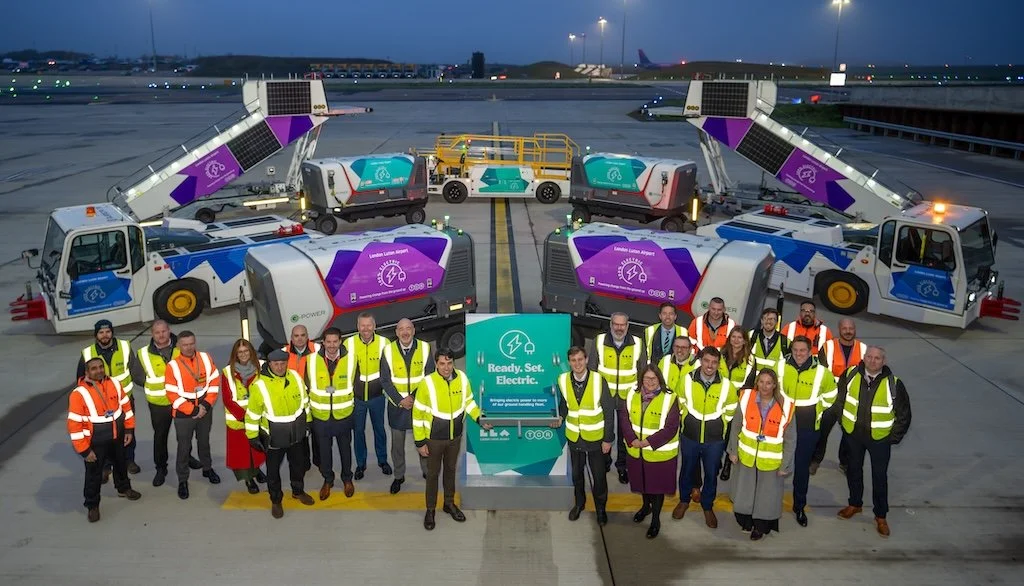
image: London Luton Airport
The airport says the move will reduce ground-level noise, carbon emissions and operating costs, while improving aircraft turnaround times.
The fleet, supplied in partnership with airport equipment specialist TCR, comprises 74 passenger boarding stair units, 44 baggage belt loaders, 35 mobile battery units and 22 aircraft pushback vehicles.
Aviation Minister Keir Mather officially activated the new equipment which will support a range of apron operations, including baggage handling, aircraft towing and passenger boarding. Under the pooled operating model, equipment is shared between airline ground handlers rather than allocated to individual airlines.
A key feature of the scheme is its mobile charging system, which avoids the need to install extensive fixed electrical infrastructure at individual aircraft stands. Mobile battery units provide power to the equipment around the apron, reducing the requirement for disruptive groundworks and additional electrical installations.
The approach follows trials across five aircraft stands in 2025, which assessed battery performance, charging requirements and operational reliability before the full rollout.
Alberto Martin, chief executive of London Luton Airport, said the transition represented a significant step in reducing emissions from ground operations and combined equipment pooling, mobile charging and infrastructure-as-a-service arrangements.
The announcement coincides with construction of a new solar farm on a 26-acre site south of the airport's runway. The facility will comprise more than 14,000 solar panels and is expected to generate up to 11.2GWh of electricity annually, equivalent to more than a third of the airport's current electricity demand.
Ground operations however are estimated to represent less than 1% of the airport's reported emissions. Figures reported by the BBC, based on airport data, indicate that ground operations accounted for 4,722 tonnes of greenhouse gas emissions in 2025, compared with approximately 1.3 million tonnes associated with flights.
The airport has planning approval to increase annual passenger capacity from 19 million to 32 million by 2043, through terminal expansion, a new terminal and additional taxiways. The airport has also committed to expanding the use of lower-carbon technologies and energy sources as it develops its facilities.
Keir Mather said the introduction of electric ground equipment, alongside investment in renewable electricity generation, demonstrated how airports could reduce the environmental impact of their operations while supporting growth.
London Luton Airport is operated by a consortium in which Aena is the majority shareholder. The airport itself is owned by Luton Rising, a company wholly owned by Luton Borough Council.