

A new report from Cranfield University, in partnership with Exeter Airport and industry stakeholders, has set out lessons learned from the UK’s first live hydrogen-powered aircraft turnaround, offering a roadmap for wider adoption of hydrogen technologies in airport ground operations.
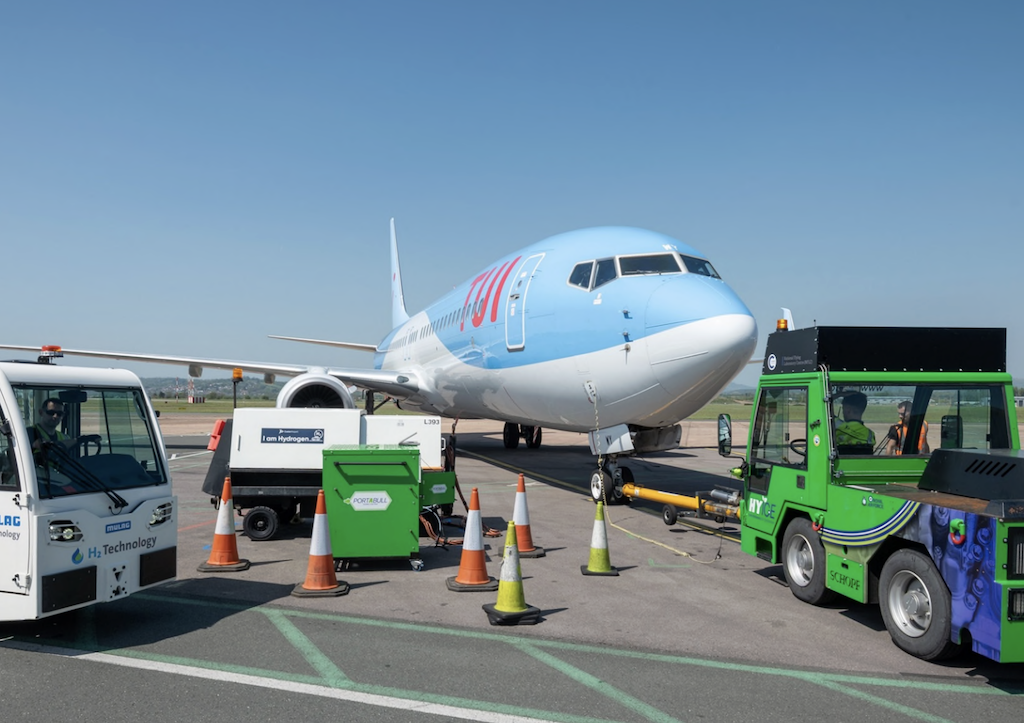
image: Exeter Airport
The Zero Carbon Turn Project trial, conducted in April 2025, involved the use of multiple hydrogen-powered ground support equipment (GSE) including baggage tugs, pushback tugs, and a ground power unit (GPU) to support a TUI Boeing 737.
The demonstration aimed to explore how green hydrogen could reduce carbon emissions and other environmental impacts from airport operations.
The newly released report analyses operational data, safety findings, and energy usage from the trial. It highlights that mobile GPUs are among the largest sources of CO₂ emissions in ground handling, and that switching to hydrogen technology would significantly reduce diesel consumption and emissions.
Professor Anna Smallwood, Head of the Centre for Air Transport Management at Cranfield University, said the report provides practical insights into how hydrogen technologies can be safely and effectively integrated into airport operations. “This research helps inform standards, procedures, and innovation pathways for the aviation sector as it moves toward net-zero emissions,” she said.
The trial was part of a wider collaboration between Exeter Airport, TUI, Cranfield University, and industry partners including ULEMCo, MULAG, and Boeing, supported by the UK Civil Aviation Authority’s Hydrogen Challenge programme. The programme aims to build regulatory readiness for hydrogen adoption and encourage replication across UK airports.
Exeter Airport’s managing director Stephen Wiltshire described the report as an important milestone, “The lessons from this trial and the report provide a foundation for integrating hydrogen into day-to-day airport operations and sharing insights with the wider sector.”
The report identifies key lessons from the Zero Carbon Turn project to be:
1. Hydrogen technologies can be safely integrated into live airport operations
The report confirms that multiple hydrogen powered ground support technologies - including a hydrogen internal combustion tug, a hydrogen fuel cell baggage tractor, and a hybrid hydrogen diesel ground power unit - can operate together airside in a real operational environment without compromising safety or performance. This demonstrates hydrogen’s viability for day-to-day airport use, not just controlled trials.
2. Building operational evidence is critical for future adoption
One off demonstrations are valuable but not sufficient: longer, broader trials are needed in varied, real world conditions to understand equipment performance, refuelling logistics, seasonal impacts and operational rhythms at airports.
3. Diverse hydrogen storage and refuelling models must be explored
The report underscores the need to test and compare alternative hydrogen storage and refuelling approaches. Establishing efficient, scalable solutions for fuelling hydrogen ground equipment - and eventually hydrogen powered aircraft - remains an operational priority.
4. Sector wide knowledge sharing will accelerate progress
To avoid duplication of effort and speed wider adoption, the report highlights the value of formalised platforms for sharing research, operational data and safety learnings across airports, manufacturers, regulators and academia.
5. Regulatory frameworks and standards must evolve
While the trial provided valuable operational insights, the analysis stresses that regulatory pathways — including safety cases, standards and airside hydrogen handling protocols - require refinement to support future hydrogen initiatives at scale.
6. Regional airports can act as early adopters and testbeds
The report suggests that smaller regional airports, like Exeter, are well positioned to host iterative hydrogen trials. Their size, flexibility and operational context make them natural testbeds for technologies that can eventually scale to larger hubs