

SkyNRG outlook sees rapid growth in sustainable aviation fuel demand
Global demand for sustainable aviation fuel (SAF) is expected to increase significantly over the remainder of the decade as regulatory mandates take effect and governments strengthen aviation decarbonisation policies, according to SAF producer and supplier SkyNRG's 2026 SAF Market Outlook, produced in collaboration with consultancy ICF.
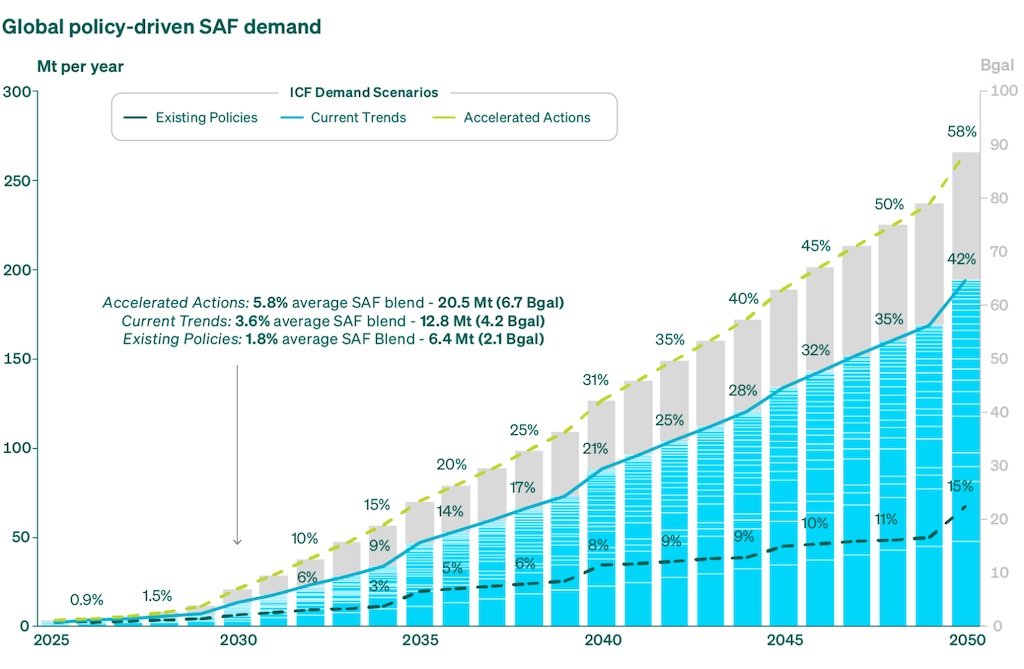
image: SkyNRG
The report forecasts SAF demand could reach 12.8mt annually by 2030 under its central scenario, compared with approximately 2mt supplied in 2025. SkyNRG said the market has entered a new phase, shifting from largely voluntary adoption by airlines to a compliance-driven model following the introduction of SAF mandates in the European Union and United Kingdom.
According to the report, global SAF supply doubled from around 1mt in 2024 to 2mt in 2025. However, the company said scaling production to meet future demand will require continued investment in new production technologies, feedstocks and infrastructure.
SkyNRG chief executive Maarten van Dijk said the market is maturing as regulatory frameworks provide greater certainty for investors and producers. He added that diversifying feedstocks and production pathways will be necessary as demand accelerates.
The outlook highlights growing differences in how regions are approaching SAF development. Europe is focused on demand certainty through mandates and market support mechanisms, while the United States has relied more heavily on incentives. In Asia, governments are increasingly supporting SAF production through industrial policy initiatives.
The report also identifies energy security as an increasingly important factor in SAF policy development. Recent geopolitical disruptions and concerns about fossil fuel supply chains have prompted governments to consider SAF not only as a decarbonisation tool but also as a means of improving fuel resilience through domestic production.
Despite continued growth in announced production capacity, SkyNRG warns that challenges remain. The report projects global SAF production capacity could reach 18.5mt by 2030, but notes that project delays, financing difficulties and constraints on feedstock availability continue to affect market development. Pressure on supplies of waste oils and fats used in current hydroprocessed esters and fatty acids (HEFA) production pathways is expected to increase as demand grows.
The company said advanced technologies, including alcohol-to-jet and synthetic e-SAF pathways, will need to scale more rapidly to avoid supply shortfalls after 2030.
Industry-wide concerns over supply availability persist. The International Air Transport Association (IATA) recently estimated that SAF production will account for only around 0.8% of global aviation fuel consumption in 2026, underlining the gap between current supply levels and long-term decarbonisation ambitions.
The aviation sector views SAF as one of the most important near-term options for reducing lifecycle carbon emissions from air transport because it can be used with existing aircraft and airport infrastructure. However, production costs remain significantly higher than conventional jet fuel, and the pace of capacity expansion is expected to be a key factor in determining whether industry and government climate targets can be achieved over the coming decades.