

The global airline industry's profitability is expected to fall sharply in 2026 as rising fuel costs and ongoing disruptions linked to conflict in the Middle East increase operating costs, according to IATA, the International Air Transport Association's latest financial outlook.
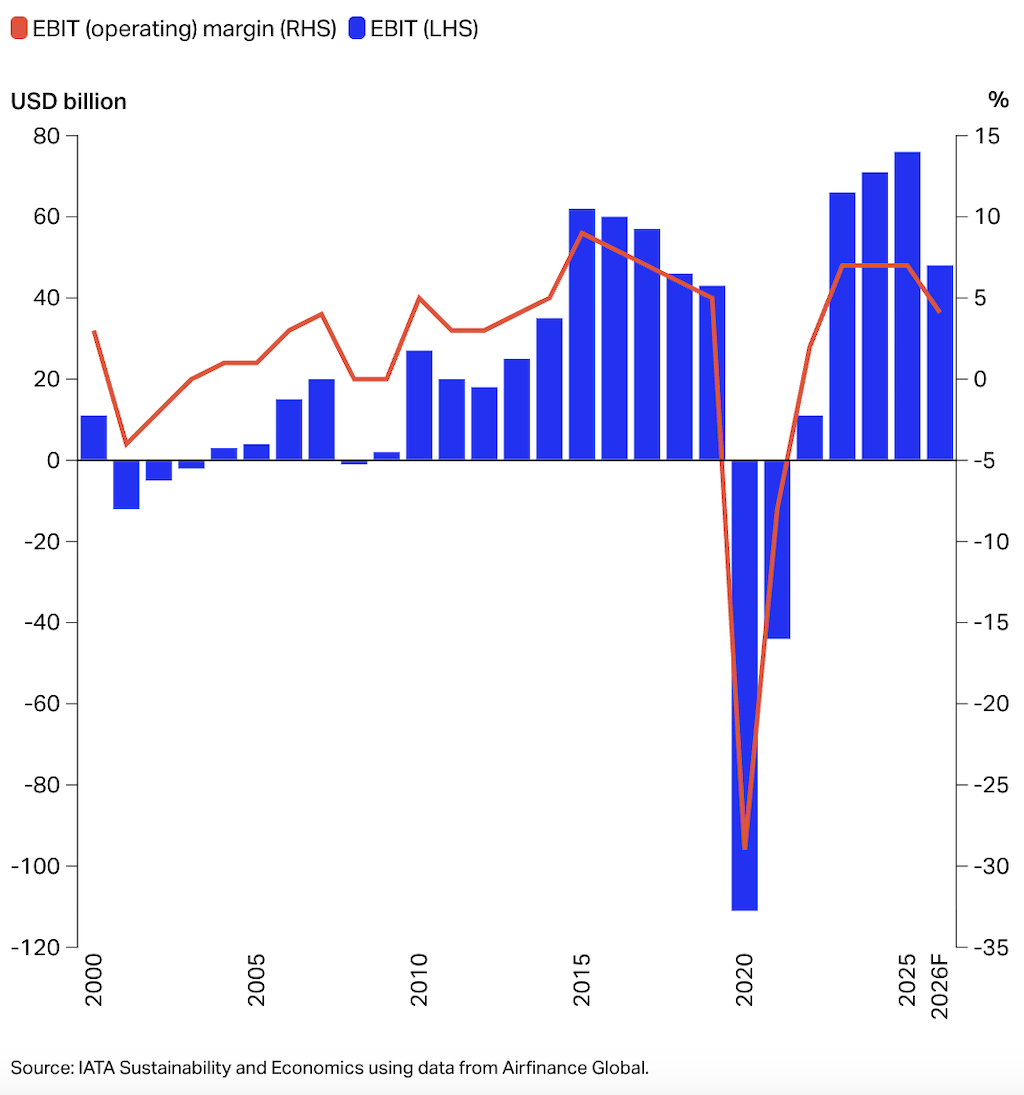
Source: IATA - Global airline EBIT (earnings before interest and taxes), USD billion, and EBIT margin, % of revenue
IATA, which has 370 airline members in over 120 countries, is now forecasting the industry will generate a combined net profit of $23bn in 2026, roughly half its previous projection of $41bn and down from an estimated $45bn in 2025. The association expects the industry's net profit margin to decline to 2% from 4.2% last year.
According to IATA, fuel costs are expected to rise by nearly 40% year on year, reaching $350 bn. Despite the pressure on profitability, global airline revenues are projected to increase 9.4% to a record $1.165 trn. Passenger ticket revenues are expected to reach $839 bn, supported by higher fares as carriers seek to offset rising costs. Passenger load factors are forecast to reach a record 84%.
Cargo revenues are also expected to grow, rising 7.2% to $162bn. However, IATA said much of the increase reflects higher yields as airlines pass through increased operating costs rather than significant growth in cargo volumes. Cargo tonne-kilometres are forecast to expand by less than 1%.
The Middle East is expected to be the only region to record a collective loss in 2026. Airlines in the region have been affected by airspace closures, flight cancellations, capacity reductions and weaker transfer traffic. IATA forecasts a net loss of $4.3bn for Middle Eastern carriers, compared with a profit of $7.2bn in 2025.
Outside the Middle East, airlines are still expected to remain profitable, although at lower levels than previously anticipated. Industry executives have warned that sustained high fuel prices could lead to further capacity reductions and place additional pressure on carriers with weaker balance sheets.
The outlook also points to broader economic headwinds. IATA expects global GDP growth to slow to 2.5% in 2026, while inflation is forecast to rise and world trade growth is projected to weaken. At the same time, aircraft delivery delays continue to constrain fleet renewal efforts, forcing many airlines to operate older and less fuel-efficient aircraft for longer than planned.
Nevertheless, the association said demand for air travel remains resilient. Survey data released alongside the outlook showed that a majority of travellers intend to maintain or increase their travel activity over the next 12 months despite higher fares and ongoing geopolitical uncertainty.